
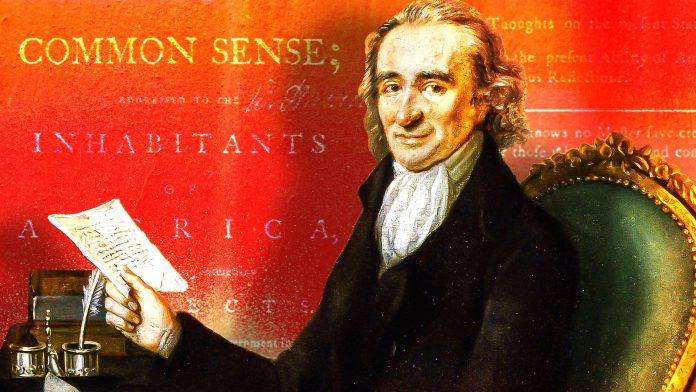


On June 8, 1809, 72-year-old Thomas Paine took his last breath inside a small house in Greenwich Village. The next day the best-selling author and revolutionary’s body was loaded onto a cart and taken to his farm in New Rochelle, about 22 miles north of New York City, for burial. There was no procession, no national moment of silence, no celebration of a life fully lived.
A small group attended his funeral, including his caretaker, Marguerite Bonneville, a friend from his many years in Revolutionary France, and her son, Benjamin. As the dirt hit the mahogany coffin, Bonneville exclaimed, “Oh! Mr. Paine! My son stands here as testimony of the gratitude of America, and I, for France!”
By the time of his death, there was little gratitude for Paine’s contributions to the United States outside of workingmen’s associations because of his blistering attacks on revealed religion, particularly Christianity. But as America barrels toward its semiquincentennial, Thomas Paine emerges as the Founding Father Americans can celebrate without regret. Unlike his contemporaries, Paine’s radical liberalism feels strikingly modern—pro-democracy, pro-market, anti-poverty, and antislavery—and worth defending as the forces of reaction mount here at home and abroad. Without the pen of Paine, in fact, there might not be a United States to celebrate today.
In January 1776, Paine’s Common Sense hit the streets of Philadelphia like a cannonball. The 47-page pamphlet was an immediate sensation. Not only did Paine reject reconciliation with Great Britain and call for independence, he attacked hereditary monarchy and aristocracy as millstones around humanity’s neck. What made the text dangerous was that Paine didn’t write it for polite society. With wit and verve, he wrote it for the masses in language any farmer or artisan could understand. But Paine went further. He had the temerity to tell common people that they weren’t mules to be driven into the mud by their so-called betters. Instead, they had the right and ability to rule themselves with dignity, the divine right of kings be damned.
Paine’s democratic beliefs terrified the more elitist and conservative Founding Fathers, most notably his decades-long nemesis, John Adams. While Adams conceded that without Paine “the sword of Washington would have been wielded in vain,” he feared Paine’s egalitarian ethos would unleash anarchy into the nascent republic. Paine’s forceful argument for universal male suffrage without a property qualification petrified Adams. (Though he had a friendship with the founding feminist Mary Wollstonecraft during his time in England and revolutionary France, Paine doesn’t seem to have commented on women’s voting rights.)
A few short months after the Declaration of Independence in September 1776, Pennsylvania made good on Paine’s democratic promise. The state’s constitutional convention—presided over by Benjamin Franklin, Paine’s friend and benefactor—codified popular democracy into the state constitution while protecting civil liberties such as free speech and the right to bear arms for self-defense. In response, the embattled nation’s working people celebrated him while the colonial elite cursed him for unleashing the unforgivable conceit: equality by birth.
Paine, however, couldn’t be typecast as a typical progressive today. As the Democratic Party flirts with socialism and Donald Trump’s MAGA movement champions tariffs, Paine’s bourgeois radicalism stands firm: Markets and private property are the best ways to combat poverty. He anticipated that great wealth could be “capable of good” and rebelled against the simplistic notion that entrepreneurs and business owners were evil. “I care not how affluent some may be,” he wrote in Agrarian Justice, “provided that none be miserable in consequence of it.” In The American Crisis, Paine insisted that trade “flourishes best when it is free, and it is weak policy to attempt to fetter it,” understanding that prosperity flowed from the free trade in goods and services between individuals and nations.
Paine, however, wasn’t an apologist for the rich or inequality. Instead, he earned the admiration of working people. Not only because he was one of them, but because he fought for them wholeheartedly. Enraged by the privilege and feudalism of the Old World and any scheme to plant such poison in American soil, Paine laid out an early proposal for social insurance to provide public education for poor children, maternity benefits for new mothers, and pensions for the infirm and elderly. But Paine didn’t see his proposal as welfare. He saw it as every individual’s natural inheritance from common land being cultivated and taken out of common use. “It is not a charity but a right,” he wrote, “that I am pleading for.” Paine thought his plan would undercut the rampant inequality and dependency that corrupted the Old World.
Unlike many in the Founding generation, Paine detested slavery. When he arrived in Philadelphia in 1774, his quarters sat next to a slave market. What he called “the infernal trafic (sic)” horrified him. Later in life he would write a sentence that connected his hatred of subjugation to his celebration of democracy and individual rights: “Man has no property in man, neither has one generation a property in the generations that are to follow.”
About seven months before his death, Paine even hurled his abolitionist views in the face of former president Thomas Jefferson, according to textual analysis by the historians behind Thomas Paine: Collected Writings, published this week by Princeton University Press. In what was considered a letter of unknown authorship to Jefferson from November 1808, Paine chastised the former president and slaveholder, reminding Jefferson of the Declaration’s language he penned. “We hold these truths self-evident; that all men, (not all white men) are created equal,” he wrote. Then he came in for the kill, telling Jefferson that if slavery was so entrenched in America then that meant it was “high time for America to give up all pretentions [sic] to liberty & freedom.” Paine’s antislavery credentials shouldn’t need defending today, but they take on new salience when the U.S. government rewrites American history to sand down slavery’s wickedness.
This year, more than ever, there is an impulse to engage in hagiography when discussing the Founding generation. Paine was far from perfect, but when it comes to the questions that matter most today, he’s the Founding Father to cast our lot with. He reminds us of America’s true covenant: the right of every person to live without a master.